Overview
Instead of postulating multiple fundamental forces and separate field types, TDFT starts from a single one-dimensional propagation constraint and shows how gravitation, electromagnetism, stable matter, and large-scale cosmic structure can be understood as different geometric expressions of that same constraint.
The Core Idea
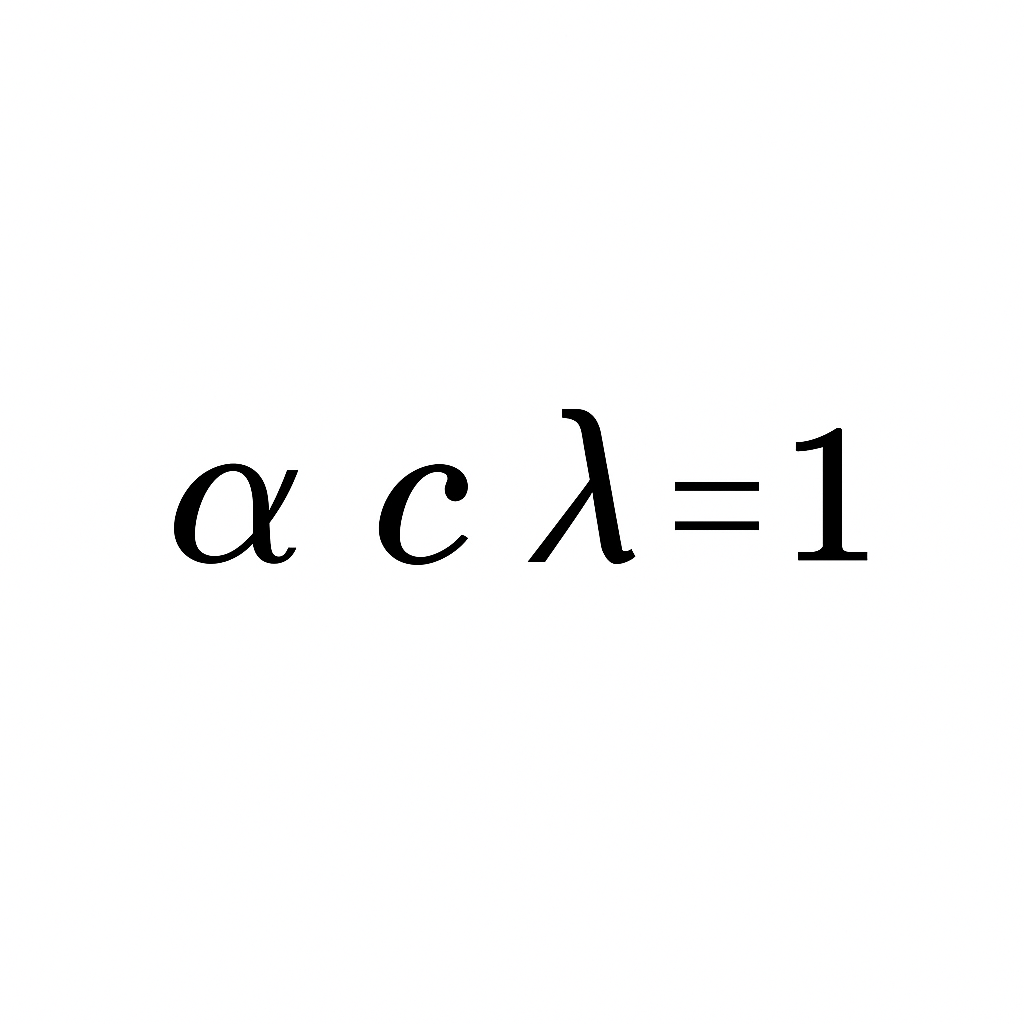
At the heart of the framework is a dimensionless relation written symbolically as α c λ = 1. Here, c is the familiar invariant propagation speed, while α and λ describe how that invariant is redistributed when space becomes its volumetric expression.
This identity is not a new “law of physics” added to existing ones. It is a statement about how a single invariant must be accounted for across volume and when parts of that invariant become distributed into matter or horizons within a spatial field. The resulting adjustments appear to us as curvature, electric and magnetic fields, and the conditions under which black holes form.
From a Single Rule to Many Phenomena
Once three-dimensional propagation becomes necessary, the invariant cannot simply act along a straight line. It has to be reconciled with all possible directions as a radial isotropy of the same invariant constraint. In TDFT, this reconciliation shows up as an isotropic tension field: a symmetric “tension” carried through shell gradients around any region where the invariant has been locally sequestered.
Different familiar phenomena then correspond to different ways of looking at the same tension field:
- Gravity appears as the radial gradient of this tension: the way it changes with distance from a mass. What we usually call “curvature” is the geometric record of that change.
- Electric fields correspond to temporal bias in how the tension readjusts from one moment to the next around charges.
- Magnetic fields arise from lateral (circulating) redistribution of the same tension when electric effects change in time.
- Horizons (such as those around black holes) mark the point where the invariant has been fully sequestered into a finite radius and the volumetric description simply runs out of room.
In this way, TDFT uses one underlying structure to describe behaviour that is usually divided between separate theories.
How This Differs from Standard Approaches
The framework does not propose new particles, extra forces, hidden dimensions, or phenomenological “dark” components. It accepts the empirical success of general relativity, quantum theory, and the Standard Model, but reorders the assumptions behind them.
Instead of treating spacetime geometry, electromagnetic fields, and quantum states as fundamentally separate ingredients, TDFT treats them as different ways of keeping track of how a single invariant is preserved across space and time. The familiar equations of physics are recovered as efficient descriptions of this deeper bookkeeping.
Canonical Works
The full technical development of the framework is presented in a small set of core works:
-
Volume 0 — Axiomatic Geometry from a Single Constraint
Introduces the primitive invariant, the isotropic tension field, and the triadic horizon, and shows how the gravitational constant G emerges from the volumetric projection of the triad.
Read Volume 0 → -
Volume I — Dimensionless Unification and Empirical Predictions
Develops the algebraic structure of the framework and sets out concrete tests linking the invariant to gravitational and electromagnetic observations. -
Volume II — Unified Origins of Matter, Dark Matter, and Horizon Geometry
Applies the framework to particle structure, the SU(3) → SU(2) → U(1) gauge cascade, dark matter, and black-hole horizons. -
Volume III — Geometric Entropy and the Origin of Cosmic Structure
Extends the analysis to cosmology, galactic morphology, rotation curves, large–scale structure, CMB coherence, and apparent cosmic acceleration.
A consolidated list of these works, with direct downloads, is available on the Volumes overview page →
Status and Access
TDFT is presented as a coherent, fully specified theoretical framework rather than as a speculative sketch. All derivations, parameter relations, and predictions are documented in citable form via the Zenodo research repository and mirrored on this site.
This overview is intended for readers who want to understand the basic idea without working through the full mathematics. For those who do wish to explore the technical details, the core paper and the three volumes provide a complete, self-contained path from the single invariant to the full range of physical structure described by the framework.