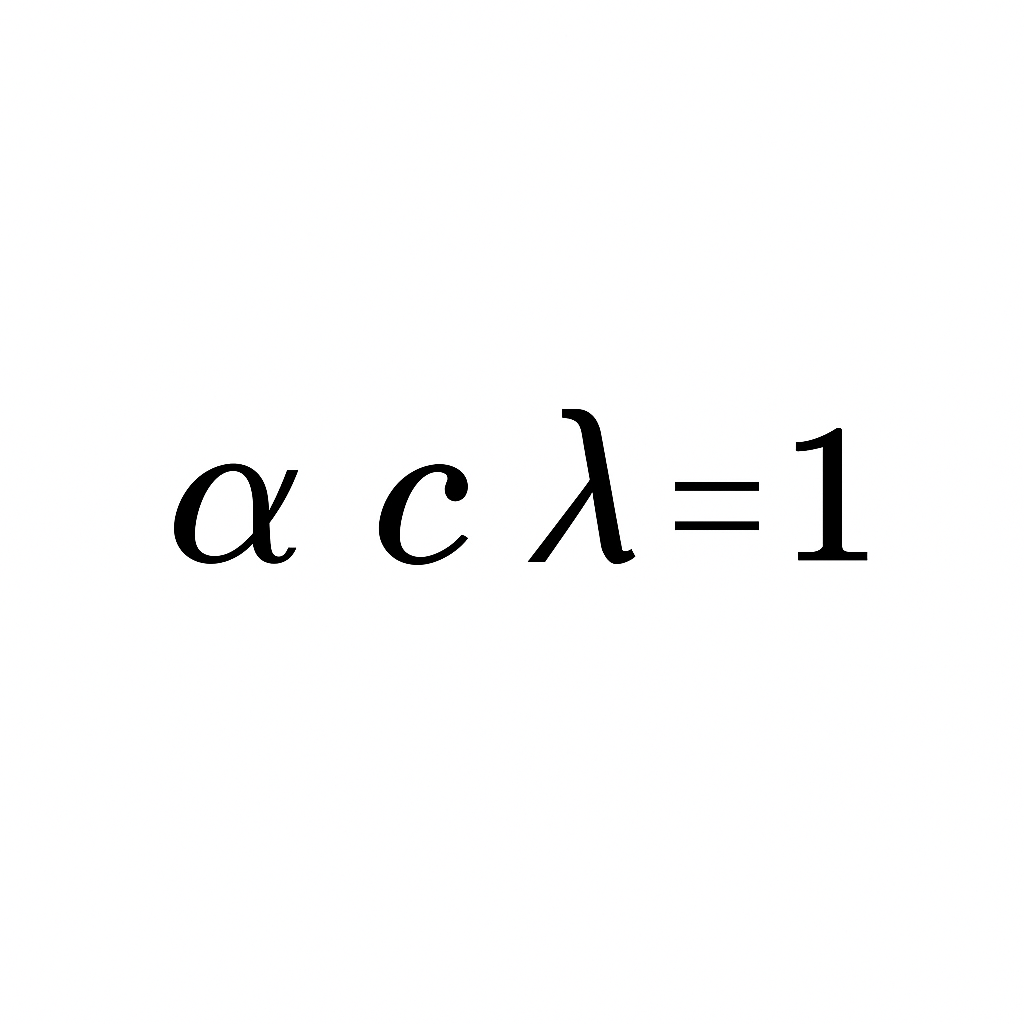
The Core Invariant
The Temporal–Density Framework is built on a single dimensionless relation: α c λ = 1.
In this identity:
- c is the primitive one-dimensional invariant governing linear propagation;
- λ is the global linear-density scale associated with horizon formation;
- α encodes the transverse equivalence of isotropy under convergence.
The triad does not introduce three independent constants; it records three volumetric projections of a single invariant. From this relation follow the isotropic tension field, gravitational coupling, and horizon conditions, without adding new dynamical primitives.
Structure of the Framework
The theory is developed in a small set of tightly connected works:
-
Volume 0 — Axiomatic Geometry from a Single Constraint
Establishes the primitive ontology: a one-dimensional invariant meeting volumetric freedom. Derives the isotropic tension field, radial and lateral projections, the triadic horizon, and the relation between α, c, λ, and the gravitational constant G.
View Core Paper → -
Volume I — Dimensionless Unification and Empirical Predictions
Develops the algebraic structure of the triad, shows how gravitational and electromagnetic behaviour arise as projections of the isotropic tension field, and sets out explicit empirical tests grounded in the invariant.
View Volume I → -
Volume II — Unified Origins of Matter, Dark Matter, and Horizon Geometry
Applies the invariant to gauge structure. The SU(3) → SU(2) → U(1) cascade is realised as a hierarchy of isotropic mediation, yielding baryons, dark matter, atomic structure, and horizon geometry as outcomes of tension redistribution.
View Volume II → -
Volume III — Geometric Entropy and the Origin of Cosmic Structure
Extends the Temporal–Density Framework to galactic and cosmological scales. Demonstrates how asymmetry between longitudinal tension and admissible redistribution produces geometric entropy gradients governing galactic morphology, rotation curves, large–scale structure, CMB coherence, and apparent cosmic acceleration.
View Volume III →
From Invariant to Fields
Once the invariant is required to remain continuous within isotropic three-dimensional space, volumetric geometry must respond. This response is encoded in the isotropic tension field: a symmetric distribution of tension across concentric shells centred on localised convergence.
Different physical regimes correspond to geometric projections of this single field:
- Radial tension — variation of isotropic tension along convergence rays. Its gradient reproduces gravitational behaviour and the effective curvature attributed to spacetime.
- Temporal-bias tension — non-uniform temporal adjustment of isotropic tension. This bias appears observationally as electric potential and field structure.
- Shear tension — lateral (angular) redistribution of tension across shells. This circulation corresponds to magnetic behaviour and its coupling to time-varying electric effects.
No additional fields are postulated. Gravitation, electromagnetism, and horizon dynamics arise as different projections of the same invariant-preserving tension geometry.
Scope of the Temporal–Density Framework
The Temporal–Density Framework provides a unified account of curvature, gauge symmetries, particle structure, dark matter, cosmic morphology, and horizon dynamics using only the invariant α c λ = 1 and the volumetric behaviour of the isotropic tension field. It introduces no new hidden sectors, phenomenological energy terms, or adjustable couplings beyond those implied by the triad.
Within this approach, gravitational curvature, electric and magnetic fields, gauge cascades, and cosmological evolution are understood as different geometric expressions of the same underlying constraint. Baryons and dark matter emerge from SU(3)-dominated compression and its mediated relief; black-hole horizons correspond to fully realised triadic horizons; and large-scale cosmic structure follows from a global tension imbalance induced during the SU(3) regime. The framework does not seek to replace established formalisms, but to re-organise them within a single, dimensionless, self-consistent structure grounded in one invariant meeting spatial freedom.